
Free Shipping Across Canada on Retail Orders Over $88, $208 for the USA. Shipping Worldwide.
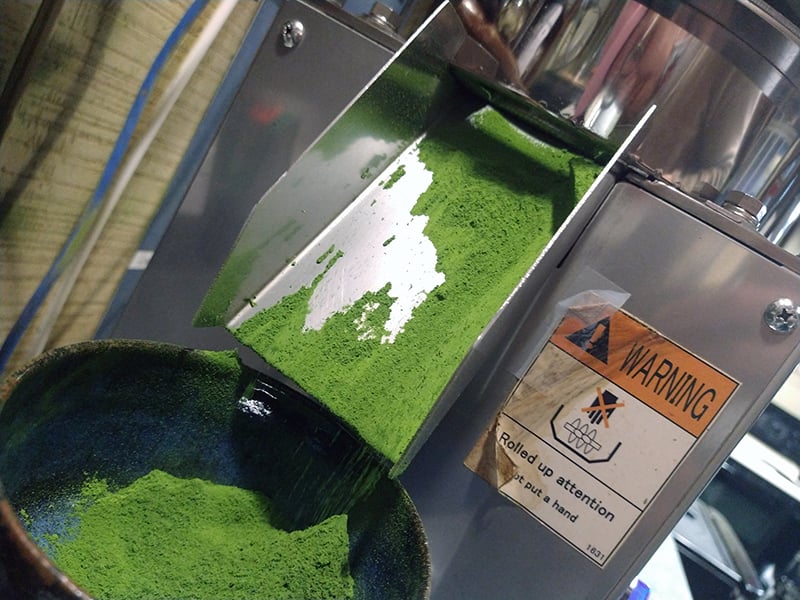
It would be cheaper and easier for us not to mill our own maccha, but we truly believe the resultant benefits are worth it. We are not only able to better manage freshness, but also optimize flavour. After much trial and error, we can confidently say we are happier with the same maccha produced through our mills than having it stone milled for us in Japan.
In the world of coffee, there used to be a romanticization of getting your beans roasted in Italy. Small batch roasters have proven time and time again that they can source and roast and make available careful selections that taste great regardless of where they are located. We used to believe that having our maccha milled for us on traditional stone mills in Japan was the only way (if we wanted to preserve ideal flavour). Through countless blind tastings and adjustments to our milling process, we have since come to believe that our milling system is on par if not better than the traditional mills.
From very early on in our career we would put the milling date on our packages. We would sell our product for 50% off once it was older than 6 months and gradually shrunk that down. We looked into getting our own stone mills so that we could have greater control over mill dates, but as they only produced 40g per hour, needed to be placed in a refrigerated environment, cost 12-15k each, and needed a stonemason to regularly sharpen them, we hesitated. We teamed up with our friend Pedro at o5 Tea and together we found a mill produced by Terada and were able to satisfy preliminary quality control tests and brought in one unit. With water running into the plates (none touching the leaves), we were able to temperature control without refrigeration, and the capacity was 1.5kg per hour, a much more viable capacity for similar money. We worked with the inventor to slow down the particulate distribution into the mill and rejoiced when they improved on the hardness of the plates, finally allowing us to reach a micron count that was finer than anything we had stone milled. We then connected the mills to a brewing chiller to take our temperature control from a 10°C margin of error to 1°C.
Now we can highlight the terroir of a cultivar by adjusting the mill temperature and fineness. We have learned that you can not only mill too coarse, but too fine as well. You can not only mill too hot, but too cold as well. We QC every kilogram we produce on our mills and find a lot of joy in optimizing every selection we bring in from each producer. We often send those same producers samples of our maccha for their feedback and get consistently great responses.
Since our 2019 foray into milling, we have learned a lot and know there is so much more to learn. We fully understand that the reality is that milling ourselves costs us more per kg than having it milled for us; but we have found that the control over milling dates, the ability to optimize by selection, and the intimate understanding that it gives us of the end product is absolutely invaluable. We have since added a second and then a third mill to meet our production needs and would never go back.
Love maccha? Sign up and get 10% off your first order. You'll also receive new articles and video content!